Thursday, February 15, 2018

THE BLUE REVOLUTION: Wanted...Imaginative Mega-Billionaire!

All of our efforts to Save Planet Earth and Humanity could well be validated with this posting today.  We all wonder if there is a purpose to our life, and one simple answer is no.  So read on.

The Big Bang, if there was one, created our Universe, and for nearly 14 billion years, stars, planets and life were created, while in sequence, pretty much at random.  It is said there might be a septillion stars out there, which is 1 followed by 24 zeroes, or a trillion trillion.  Yet, we might well be the only life form anywhere.  Until we get obviously alien signals (flying saucers are pure fantasy) confirmed to be real, we are the only intelligence.  Next, maybe robots and artificial intelligence, but those won't be developed unless humans perfect them.

Life is tough, for forming only a little more than 300 million years after Planet Earth appeared 4.6 billion years ago, of the more than five billion species, 99% are now extinct.  Evolution and extinctions resulted in hominins (our earliest ancestors) perhaps 6.5 million years ago.  Mammoths only appeared 4.8 million years ago.  The first Homo genus came as long as 2 million years ago, with us, Homo sapiens, possibly 200,000 years ago, but these dates keep changing.

BBC has an excellent video of the 25 biggest turning points in our history, ending with the advent of Man, so let me move ahead to 2000 years ago with Jesus Christ, while new technology like light begun to come two centuries in the past.  We now have 7.6 billion people and 19 billion chickens, but we are exceeded by maybe 100 billion rodents.  These numbers pale to the 200 trillion 3-inch bristlemouth fish living at the bottom of the ocean.

Many of us have problems with ants, and now you know why.  There are a septillion of them.  Again 1 followed by 24 zeroes. There are more bacteria in a gram of dental plaque than all the people who have ever lived.  We can go on and on, but let us end by saying that there are 1 followed by 31 zeroes worth of viruses, and placed end to end (and you can imagine how small they are) you wouldn't be able to guess how far they would stretch.  We'll tell you anyway, 100 million light years, just about the diameter of the Milky Way Galaxy.  But viruses aren't alive, are they?

By now you should be impressed about life on Planet Earth anyway.  So what has all this to do with the Blue Revolution?  Well, Humanity is at the threshold of ruining our world with global warming and not particularly liking each other to boot.
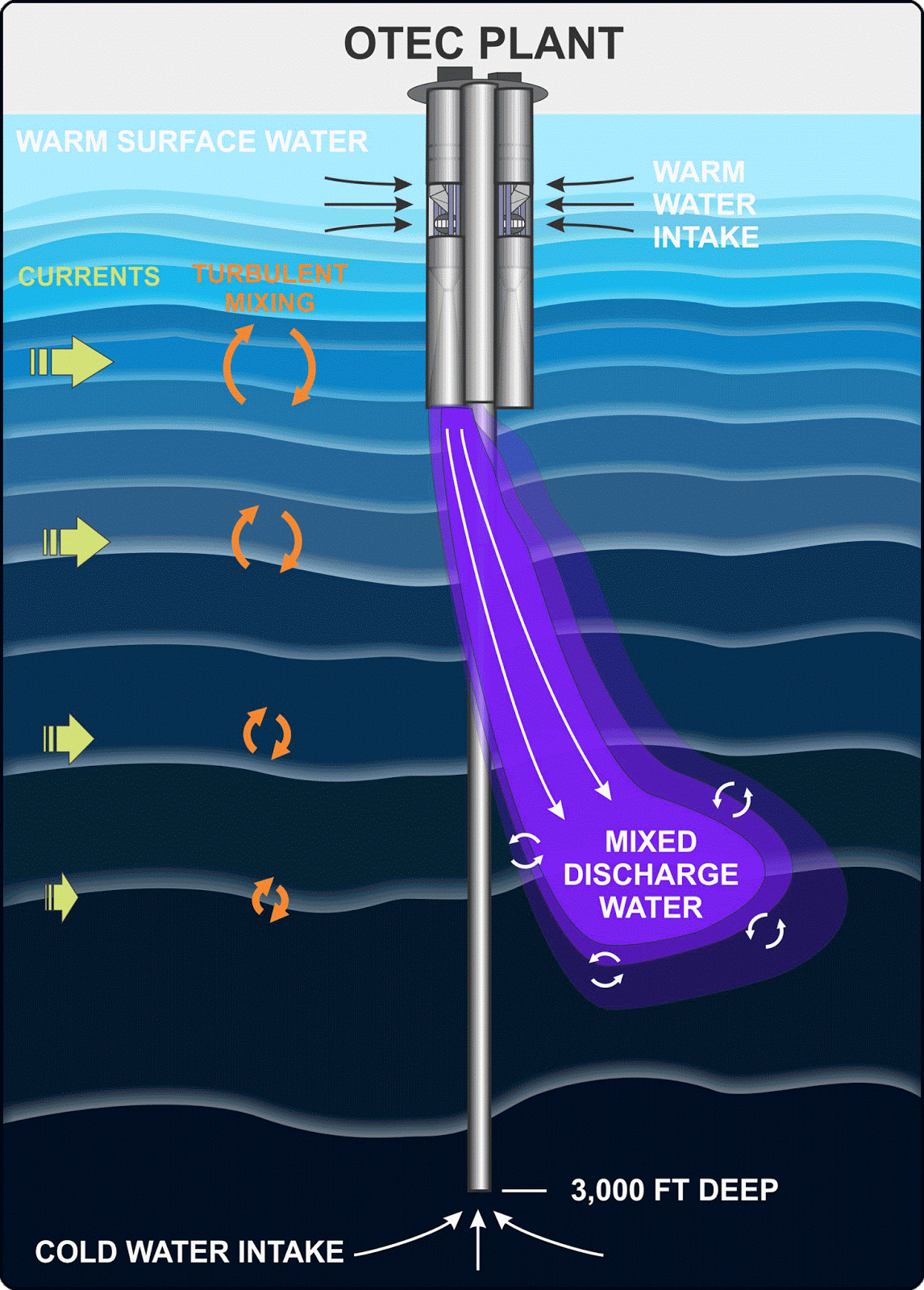
The solution?  The Blue Revolution.  Here is a future that will only happen if the world gets together and proceeds to develop OTEC, using this technology to power floating cities and industrial parks, while producing sustainable energy and resources, plus remediating climate change and minimizing tropical storms.

What is standing in the way of progress?  Money. And motivation.  An iPhone 10 sells for less than $1000.  The Pacific Ocean International Station, the first proposed step towards the Blue Revolution, could easily run beyond $1.5 billion.  There is no financing mechanism for anything so risky and bold.

The Apollo Project was indeed a giant leap for mankind, and came in with an initial budget of $25.4 billion 55 years ago.  Today, the value is $200 billion.  But the USA chose to go to the Moon by 1969 mainly for political reasons.  We were concerned about the Soviet Union, and this decision helped to bankrupt our adversary, ending the Cold War two decades later.

The Blue Revolution does not have the glamour of the Mars Project.  There is a range of cost estimates, but $1.5 trillion sounds about right to get to that enigmatic globe.  Elon Musk says he can do it cheaper and earlier.

In any case, how many can afford Musk's $200,000 flight ticket for tourists to get there?  Maybe this was only a one way price.  So, we reach Mars, what is the point?   Walking on the Moon ended the Cold War, and this was worth $200 billion. But Mars?  Billionaires missed the memo that said outer space has become obsolete for now.

Some mention space mining.  But for what mineral?  Others point to Stephen Hawking's prediction that we only have a century left before something terrible happens on Planet Earth.  Business Insider reports on five reasons why we need to colonize Mars now:
  • Ensure survival of our species.  (Asteroids?  Far-fetched.  The last serious impact was 66 million years ago when the dinosaurs died off.  We are supposedly now in a serious sixth extinction event, but I can't get too excited about the lethality.)
  • Discover life on Mars. (We have failed so far with remote instrumentation, but if life is found, so what?)
  • Improve quality of life on Earth (I miss this point).
  • Growing as a species.  (Huh?  Going to Mars is an awfully expensive way to grow-up, in fact, sounds irresponsible to me.)
  • Demonstrating political and economic leadership. 
On that fifth reason above, yes, it would be a fine achievement for the world to partner for the good of Humanity and Planet Earth.  But any Mars project will not result in anything all that useful, save for some dubious ego satisfaction.  What about the Blue Revolution?  The former would be an amazing feat if life is found and a few end up surviving on the Red Planet.  But that's about all.  The latter:
  • Sustainable energy and resource pathways:
    • hydrogen
    • freshwater
    • biofuels
    • methanol
    • rare earths
    • much more
  • New economic development.
  • Attractive habitats for an alternative life style.
  • Replenishment of fisheries.
  • Prevention of hurricanes.
  • Remediation of global warming.
I can add to the above cornucopia of benefits, but this comparison is almost pointless.

Mind you, one of us once worked for NASA's Ames Research Center on the Search for Extraterrestrial Intelligence, and we all are fans of space.  We should continue much of the scientific activity, and more, really.  Someday, of course, we almost surely might need to send pioneers to other worlds.  But the timing is not now.  In a millennium, maybe, but more probably closer to a million years when we have mastered travel through wormholes, if that is ever achieved.

The 2017 Forbes billionaires list numbered 2043.  Their total net worth was $7.67 trillion.  Bill Gates has been #1 for 18 of the past 23 years and Jeff Bezos, who is now #3, added $27.6 billion in one year.  Mainland China had 76 newly recognized billionaires.  Click on iBlue Revolution to review a history of analyses regarding billionaires and the Blue Revolution.  To quote one posting:


In any case, you don't just go up to a billionaire and ask for money.  You need that key connection, compelling vision and fundamental link to a special passion.  Most desire to help the downtrodden, prevent diseases and reverse poverty.  Surely, among the 2000 psyches there just has to be a particular enlightened individual dedicated to Planet Earth, wishing for something extraordinary to provide some key commodities in harmony with the natural environment.  For only $1.5 billion--one percent the cost of the International Space Station, a $150 billion space adventure that meant well, but will crash into oblivion in the Year 2020--the Blue Revolution represents the next economic frontier for Humanity to generate a cornucopia of sustainable products while enhancing our environment.

We tried, even personally donated funds to  show commitment, and certainly haven't given up on finding a major benefactor.  But perhaps you're better suited to involve that special tycoon.  If so, you really don't need us.  Go ahead, take the leadership role.  Involve that billionaire to Save Humanity and Planet Earth with the Blue Revolution.  Glad to be of service should you need any advice.

Practicality will prevail, so the first Blue Revolution prototype will no doubt be placed in a reasonably ideal location where natural conditions will permit the utilization of OTEC.


Frankly something closer to the equator would be best, for no hurricane has ever crossed from one hemisphere to the other, plus this is where the surface temperatures are at a maximum, with 4 degrees Celsius still available at 1000 meter depths.

All things considered, then, Hawaii would be the perfect spot to build and test the Pacific Ocean International Station because we have succeeded in more workable OTEC experiments than anyone else, have a thriving Natural Energy Laboratory Laboratory Authority to provide expertise and have chaired more conferences and workshops  on related subjects.  As mentioned two days ago we already have billionaires with close association to this 50th State with ideal names:
  • Pierre Omidyar International Station (POI Station)
  • Larry Ellison International Station (LEI Station)
We can add a third:  Pacific Ocean Steve Case or POS Case, a stretch, but there no doubt are others.  We would welcome someone from Japan, China or anywhere else.  Most important is that sincere drive to consider the ocean as the solution for Humanity and Planet Earth. 

Anyone reading this posting linked to a potential mega-supporter, please contact Blue Revolution Hawaii.  Three coordinators are co-authoring a presentation on the Blue Revolution at the Paris Hotel in Las Vegas next week:
  • Leighton Chong (left, LKMChong@aol.com) directs the Hawaii effort, is a patent attorney and trademarked Blue Revolution for our organization,
  • Benny Ron (right, TetsuzanBennyRon@gmail.com) originally from Israel with a special zen association in Japan, is marshaling the session, and
  • Patrick Takahashi (PatKenTak@hotmail.com) will give the talk.
That billionaire would not be expected to personally come up with the full $1.5 billion.  He/She can serve as the illuminous catalyst to launch the effort...someone who convert Fantasy into REALITY.

- 

Tuesday, November 14, 2017

THE LATEST PROGRESS ON THE BLUE REVOLUTION

Half of you reading this blog could well be first-time viewers, so let me begin with a short tutorial on what exactly is the Blue Revolution.  I can send you to SIMPLE SOLUTIONS for Planet Earth, which has a full chapter on this subject, but let me begin with several articles published in The Huffington Post:

Here is a 20-minute clip from a gathering hosted by the Seasteading Institute (SI) in San Francisco, providing further details on the Blue Revolution, and, in particular, the Pacific International Ocean Station, proposed by Blue Revolution Hawaii.  SI recently hosted a conference in Tahiti and has found another partner in this French colony.

Joe Quirk moderates an excellent summary of what is becoming the Blue Revolution.  You spend hours/day watching television.  In a fraction of that time, by clicking on what he has titled, The Eight Great Moral Imperatives, you, too, can become a Blue Revolution Pioneer.  Joe also recently published a book:


The Seasteading Institute, founded by Patri Friedman and Wayne Gramlich, with funding by Peter Thiel, is leading the way towards a future of seaborne platforms in international waters.  They believe this future is now, and the effort should be entrepreneurial.

Blue Revolution Hawaii, working with SI, is using a more traditional strategy, with plans to design, build and operate a developmental floating city to best determine future marine economies and technologies.  We have already secured an endowment for the University of Hawaii to initiate the program.  While we, too, seek governmental and industrial funding to carry out this mission, we most seek an imaginative and dedicated billionaire to gain a legacy as the founder of the Blue Revolution, for the initial project, the Pacific International Ocean Station (PIOS), is anticipated to cost $1.5 billion
.  

While significant, it should be noted that the International Space Station (ISS) has already cost more than $150 billion, and is expected to crash back into Planet Earth within a decade without the formation of even one company.  Thus, for one percent of the ISS, PIOS will develop a range of sustainable ocean resources in harmony with the marine environment.  In fact, two  natural benefits could well be remediation of global warming and prevention of hurricane/typhoon formation.  

The next Economic Frontier will certainly not be Mars, but the Blue Revolution, with prospects for enhancing the environment.  The ISS is one of half a million pieces of observable space junk up there, and each one cost a lot of money.

So what am I doing to stimulate progress for the Blue Revolution?  Well, for one, I am responsible for that endowment to the University of Hawaii, and a post-doc from Nihon University is soon to arrive to help initiate some research.  I recently gave several speeches touching on this topic:
  • My talks to MENSA (at their Pacific Regional Conference in Honolulu)
  • A testimonial I provided in Tokyo (right) on the retirement of Tadashi Matsunaga as President of Nokodai, also known as Tokyo University of A&T.  Interestingly enough, a quarter century or so ago, Professor Matsunaga served as the first International Professor for the Blue Revolution at the University of Hawaii.  I suggested, as he now has nothing to do (which actually is not so, for he is even more involved now with too many things--former president of Japanese universities become especially important citizens) he might want to return to Hawaii to help lead this effort.

For the future, I was asked to present a talk in Las Vegas to the February World Aquaculture Society gathering, co-authored by Leighton Chong and Tetsuzan Benny Ron:

Blue Revolution Hawaii:  Proposal for a Pacific International Ocean Station.

Click on these two blog sites for more information:
While not yet organized as a real Blue Revolution activity, you can nevertheless from January of 2020 join me for a World Cruise.  Hopefully, Tadashi and Mayumi Matsunaga will be on board, for he was the one who stimulated this fantasy.  You can even help us select the cruise line:


Crystal for $30,955 could well be the Blue Revolution ship of choice.  Four months to cruise the world:


That itinerary is for 2018, so by 2020 maybe Crystal will truly go around the world...and probably cost more.  That is currently my problem, as these global journeys only feature cabins for two people.  I can barely afford myself, so a companion needs to be able to absorb her own cost.  Better yet, perhaps I'll find someone who could help subsidize my fare.  Amazingly enough, there are a few potential candidates who have progressed through either step two (join me for lunch or dinner so we can talk about it) or step three (a short cruise to determine if we are compatible).  Step one is just contact me.  Still searching for the perfect prospect, and some decision needs to be made by next year.

The key requirement for the Blue Revolution is to find that second billionaire (SI has Peter Thiel), or team of them, visionaries emboldened to develop the pathway for Humanity to ensure for a sustainable Planet Earth.  The sea around us is the most sensible and affordable setting to advance this cause, and the endeavor will only be attained with the right leadership and inspiration.


-

Tuesday, July 12, 2016

IS THERE A BILLIONAIRE IN YOUR FUTURE?


I long ago came to a conclusion that the government and corporate sectors of our community just do not have the imagination and resources to fund visionary pathways for Humanity.  Something like the Blue Revolution, for example, needs enlightened billionaires searching for their legacy.  Surely, out there is one with a blue dream.  How do you interest one in supporting your cause?  Read on.

The latest Forbes billionaires list shows eight from the U.S. in the top ten, with Bill Gates #1 at $75 billion, and brothers Charles (on the right) and David Koch at #9 and #10 with a total of $79.2 billion.  The brothers, incidentally, financed the Tea Party takeover of the GOP and are considered to be the most important Republicans in the country.  However, because of their disdain for Donald Trump, the Kochs decided to delete their nearly billion dollar campaign funds from national politics.  Charles, gasp, actually intimated that he could well support Hillary Clinton.

The number of billionaires dropped from 1,826 last year to 1810 in 2016.  They have a total net worth of $6.5 trillion.  Wealth-X earlier this year named the 50 wealthiest people:
  • 9 from the USA
  • only 4 from China
  • 4 females
  • youngest is Mark Zuckerberg at 31 with $43 billion
  • #1 is Bill Gates with $87 billion
  • #5 is David Koch with $47.4 billion
The details differ among the six organizations doing these billionaire surveys,  as one might report a list of 1,810, and another 2,400 (Wealth-X).  Wealth-X alone has a staff of 250 in 10 global centers mostly focusing on wealth intelligence.  In any case, according to Caroline Feund of the Peterson Institute for International Economics: A best estimate is better than no estimate with wealth.

Billionaires are now mostly self-made:


If you have a campaign to tap one of them, start with some universal information:
  • average age of 63
  • 90% married
  • 6% divorced
  • most born in the year of the Snake
  • Harvard is most common university

On the other hand, Forbes has this comparative bar graph:


Elon Musk and Donald Trump went to Penn.  

In any case, you don't just go up to a billionaire and ask for money.  You need that key connection, compelling vision and fundamental link to a special passion.  Most desire to help the downtrodden, prevent diseases and reverse poverty.  Surely, among the 2000 psyches there just has to be a particular enlightened individual dedicated to Planet Earth, wishing for something extraordinary to provide some key commodities in harmony with the natural environment.  For only $1.5 billion--one percent the cost of the International Space Station, a $150 billion space adventure that meant well, but will crash into oblivion in the Year 2020--the Blue Revolution represents the next economic frontier for Humanity to generate a cornucopia of sustainable products while enhancing our environment.

-

Monday, December 9, 2013

THE POWER OF BILLIONAIRES

Governments are essential to preserve peace,wage war and run the country.  The private sector, with government cooperation and control, determines the economy.  

However, there is this gap between research and commercialization that remains hazy.  Japan supported  business conglomerates (this all started with the zaibatsus and morphed into keiretsus) with funds and other incentives, going back to the Edo period when Sumitomo and Mitsui began, followed by Mitsubishi during the Meiji Restoration.  You will see the same companies teaming on major projects around the world.

South Korea has a similar corporate blueprint with their chaebol, first termed, actually, in 1984.  However, the system  collapsed during the Asian financial crisis in 1997.  It was around this time that the Federal government did a very smart thing.  They targeted future technology areas to gain world leading status.  Today their smart phones, flat screen television sets and home appliances are at the top.  Swift advances are being made in biotechnology.  Their entertainment industry has gained eminence, from TV soap operas to PSY's Gangnam Style, the most popular video in the history of You Tube, now approaching 2 billion clicks.

The United States is particularly effective when threatened.  We had to do something about Hitler and his possible Atomic Bomb, so we invented the Manhattan Project, spent $30 billion (really, only $2 billion then) just on the Bomb and won the Second World War.

Twenty years later, the Cold War and the Soviet Union inspired President John F. Kennedy to support the Apollo Project.  Sending Man to the Moon cost us $100 billion ($25 billion then).


In a how dumb can you get effort, George the Younger Bush wasted $3 trillion (that's $3,000 billion)  on terrorists!  Only government can squander so much money so quickly.

All the above is backdrop to the next phase of future economic development.  The American and European governments show little interest today in doing anything inspirational.  There is a perceptible shift to the power of billionaires, who have no one to answer to than their emotions.


Forbes has an annual issue on billionaires, and on the latest cover (above) is 6' 8" Mikhail Prokorov, only #69 with a net worth of $13 billion, but he owns the NBA Brooklyn Nets and could well become the next president of Russia.  Here is their map:


Click on it to read the details.

In 1916, John Davison Rockefeller became the first American billionaire.  The top five billionaires today are:

  #1  Carlos Slim Helu          $73 billion     telecom     Mexico
  #2  Bill Gates                      $67 billion    Microsoft   U.S.
  #3  Amancio Ortega           $57 billion     Zara           Spain
  #4  Warren Buffett              $54 billion    Berkshire    U.S.
  #5  Larry Ellison                 $43 billion    Oracle         U.S.

There are 1426 billionaires worth $5.4 trillion.  The USA has the most, 422, worth $1.87 trillion, with Asia Pacific next at 386 and Europe #3 with 366.

How would they compare in history?  Inflation adjusted, not that well, actually:

  • #1 Mansa Musa I –  $400 Billion (right, he ruled West Africa's Malian Empire in the early 1300's)
  • #2 The Rothschild Family – $350 Billion
  • #3 John D. Rockefeller – $340 Billion
  • #4 Andrew Carnegie – $310 Billion
  • #5 Nikolai Alexandrovich Romanov – $300 Billion
    • #6 Mir Osman Ali Khan – $230 billion (right, he ruled part of what is now India, passed away in 1967 and had 149 children)
    • #7 William The Conqueror – $229.5 Billion
    • #8 Muammar Gaddafi – $200 Billion
    • #9 Henry Ford – $199 Billion
    • #10 Cornelius Vanderbilt – $185 Billion
    • #11 Alan Rufus – $178.65 billion
    • #12 Bill Gates – $136 Billion

    However, these mega-wealthy today are, really, the only hope for out of the box monumental efforts to save Planet Earth and Humanity.


    I have a special fascination for billionaires because I see no way the state of Hawaii can overcome our handicaps without a close partnership with a few of them.  Fortunately, several have homes here, including #5, Larry Ellison, who recently purchased the island of Lanai.  Plus, there are 386 more in the Asia Pacific region.  In the past I posted on how the University of Hawaii can become great and our one chance at bootstrapping our economy into prosperity with the proposed Pacific International Ocean Station, advocated by Blue Revolution Hawaii.  As the end of the Cold War ended our need to spend billions in outer space, the ocean has become our next frontier challenge, and a few inspired billionaires can make the difference for ultimate economic/environmental progress.

    THIS POSTING IS LINKED TO Blue Revolution Hawaii, a blog site dedicated to developing the Pacific International Ocean Station.

    -

    Tuesday, September 24, 2013

    GOOGLE, CHINA AND BILLIONAIRES


    I have now identified three distinct entities capable of funding the Pacific International Ocean Station:

    • billionaires
    • China and Japan
    • Google
    The current issue of TIME magazine (30September13) has a cover article entitled, The Audacity of Google:  Larry Page and the Art of the Moonshot.  This has nothing to do with space adventures, but, instead, according to the co-founder and CEO:

    ...we should be spending a commensurate amount with what normal types of companies spend on research and development and spend it on things that are a little more long term and a little more ambitious than people normally would. More like moonshots.

    The five richest people in the world are:  

    Google has a cash stockpile of $54 billion, which would place it as #4.  

    The key to this fund is Google X, a secret facility overseen by Sergey Brin (left--most of his wealth remains in Google, but he has already sold $3.6 billion of Google stocks), one of the co-founders, currently overseeing 100 projects on future technologies.  One of them is Makani Power, a company  using tethered kites with wind turbines at 1000 feet.  Two years ago, Google invested $168  million on the Ivanpah Solar Electric Generating System, so the firm is green in philosophy.  No nuclear or coal futures, best as I can figure out.

    How can any of these renewable projects compare to the Pacific International Ocean Station, a proposed $1.5 billion (ONE percent the cost of the International Space Station--right) open ocean platform with a mission to:
    • develop the open ocean as the next economic frontier
    • in a manner which would harmonize development with marine environmental enhancement
      • remediate global warming
      • minimize hurricanes
    • produce a cornucopia of sustainable products
      • electricity
      • freshwater
      • next generation fisheries
      • marine biomass plantation
      • future of farming (the world is nearing peak phosphate, and deep ocean effluents offer the best hope for sustaining food production)
      • green chemicals and materials
      • biofuels
      • hydrogen
    • while offering promise for Disney-at-Sea, marine industrial parks and floating cities.
    Alas, I have no connection to Larry Page nor Sergey Brin, except that we all went to Stanford University.  Captain of Moonshots at Google X is Astro (below, formerly known as Eric) Teller.  However, I also don't know him, although I  did  work for his paternal grandfather, Edward Teller, at the Lawrence Livermore National Laboratory:


    Anyone of noteworthiness reading this posting, please kindly forward to your contact at Google X.  Mahalo.

    INCIDENTALLY, I HAVE A COROLLARY POSTING ABOUT GOOGLE AND IMMORTALITY IN MY OTHER BLOG ON PLANET EARTH AND HUMANITY.  CLICK ON:

      Will Google be able to Commercialize Eternal Life?

    -

    Friday, August 16, 2013

    B612 COULD SAVE HUMANITY

    Last night, former astronaut, Ed Lu (here with Leighton Chong and Benny Ron), provided the third of Sheraton Waikiki's lecture series with the Institute for Astronomy at the University Hawaii in Kennedy Theatre on Astronomy Saves the World:  Protecting the Planet from Asteroid Impacts.  As a former employee of NASA at the Ames Research Center, it is no big secret about my attitude towards space:
    • NASA was absolutely essential for Project Apollo, which helped bankrupt the Soviet Union
    • The price tag was $25.4 billion, which today could well be worth up to $300 billion
    • Certainly, the cost was well worth it to help end the Cold War
    • NASA remains important to develop space-bio sciences to stimulate the imagination of the  coming generations
    • However, the end of the Cold War made NASA obsolete as a hardware/systems organization, for the expenditure of many billions on irrational attempts to reach Mars, and similar misadventures are beyond the pale--these could well someday be necessary, but probably centuries or milllennia into the future
    • One mission worthy of a full-scale effort is to detect and deflect large incoming asteroids
    However, according to Dr. Lu, NASA is just not interested in taking on this task.  He said there are two steps:
    • use a space infrared telescope to map those incoming disasters
    • design a system to deflect it
    The B612 (named after the home of the Little Prince from Le Petit Prince) Foundation has proposed to undertake the tougher mission, step one.  However, the cost should only be around half a billion dollars.  Money is regularly raised by civic organizations across the country at these sums just to add a wing to an art museum.  Surely, there must be a billionaire or two willing to provide the funds to save humanity.

    He wasn't being sarcastic.  Once B612 finds a potential killer asteroid, he has confidence that governments will partner to build a spacecraft equipped to deflect it.  He says, while much more expensive that finding the target, there should be no technical hurdles to overcome.  Being an astronaut, he must know what he is saying.

      How serious is this threat?


    Over the next hundred years, if no precautions are taken, there will be a 30% chance that an asteroid, if it strikes a city, could wipe it out.  Of course, the odds are low that this space rock will hit a city, but it's possible.  The 1908 Tunguska event over Russia was a 200-600 foot wide asteroid (which did not actually impact our planet--it exploded at an elevation of 2-6 miles).  This is another reason why you don't actually see too many monumental craters on land.  We have detected maybe 1% of the asteroids this large.   Project Sentinel (right) will find them.

    There is a 0.001% chance that an asteroid ten times the diameter (say 2/3 of a mile) could impact Planet Earth.  This would permanently eliminate humanity.  Somewhere in between is that "medium" sized cataclysm that could kill 100 million people.  This one is at a scary 1% probability.  Most of us have fire insurance for similar probabilities.  But there is no current insurance for this killer asteroid threat.  Thus, the B612 Foundation was created.

    It was a dozen years ago that Ed Lu and Piet Hut brought together 20 space experts at the Johnson Space Center to discuss the concept.  A year later, B612 was formed.  They now have secured $20 million and have a launch date of 2018.   In many ways, Blue Revolution Hawaii is, then, well on track to gain similar funding, for our founders first met three years ago and formed this 501 c3 nonprofit organization a little more than two years ago.  If we follow their timeline, our Blue Revolution plant ship should become operational around 2025.  However, I'm impatient, and would like this monumental event to happen in the Year 2020.

    -